Indonesia:
Scaling Inclusion with Confidence
Inclusion in Indonesia is multi-layered. MSME financing remains a national priority, yet traditional credit models struggle with thin files and fragmented data. As a result, decision-makers are actively exploring alternative data, supply-chain visibility, and ecosystem-level verification to unlock lending without increasing default or fraud exposure. These conversations extend naturally into Shariah-compliant financing, where transparency, traceability, and risk sharing are essential to scale participation while meeting religious and regulatory expectations. At the same time, ESG financing is moving from policy ambition to execution reality. Banks and fintechs are under pressure to demonstrate impact, particularly for MSMEs, while ensuring data integrity and auditability. This is driving interest in platforms that can connect identity, transaction data, and reporting without adding manual overhead or weakening controls.
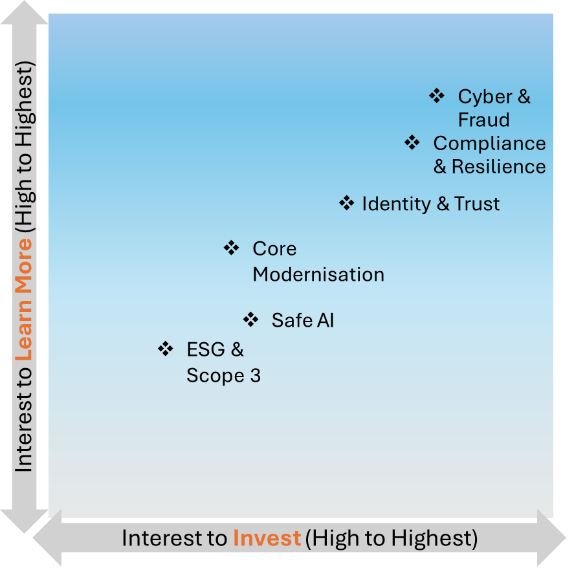
Our data shows strong meeting interest in identity and trust infrastructure, cyber and fraud protection, and MSME credit and data partners. Leaders are seeking ways to strengthen onboarding and verification, protect fast-growing ecosystems, and enable inclusive lending models, conventional and Shariah, at scale. Interest in AI and analytics is present but measured; adoption is conditional on explainability, monitoring, and alignment with conservative risk appetites.
Cloud, integration, and real-time data capabilities are viewed as necessary foundations but buying decisions are rarely made for infrastructure alone. Urgency concentrates where solutions directly reduce leakage, strengthen trust, and enable MSME, Shariah, and ESG financing to scale without increasing systemic risk.
What This Means
For technology vendors, Indonesia rewards a risk-first approach to inclusion. Solutions that help decision-makers expand access while maintaining control move quickly. Those that introduce complexity, require heavy manual oversight, or depend on perfect data conditions struggle to convert.